## Clarify the Goal for Verifying hoka Winter Shoe Parcel Costs If you plan to find a pair of [hoka](https://fashion-reps.net/brand/hoka) winter [shoes](https://fashion-reps.net/shoes) through fashion-reps and then complete the order and shipping on an external shopping agent, the easiest thing to misjudge is not the sticker price on the product page, but the final parcel costs. The item price, agent service fee, payment fee, packaging fee, international shipping fee, and exchange rate may appea
Clarify the Goal for Verifying hoka Winter Shoe Parcel Costs
If you plan to find a pair of hoka winter shoes through fashion-reps and then complete the order and shipping on an external shopping agent, the easiest thing to misjudge is not the sticker price on the product page, but the final parcel costs. The item price, agent service fee, payment fee, packaging fee, international shipping fee, and exchange rate may appear on different pages, and some fees can only be confirmed after the warehouse weighs the package or you select a shipping route. 📦
This article tackles one specific task: before paying, build a verifiable cost record to determine whether the currently displayed amount is enough to place the order. This article does not provide fixed shipping fees, nor does it replace the agent platform's final confirmation of routes, destination country taxes, import restrictions, or after-sales policies.
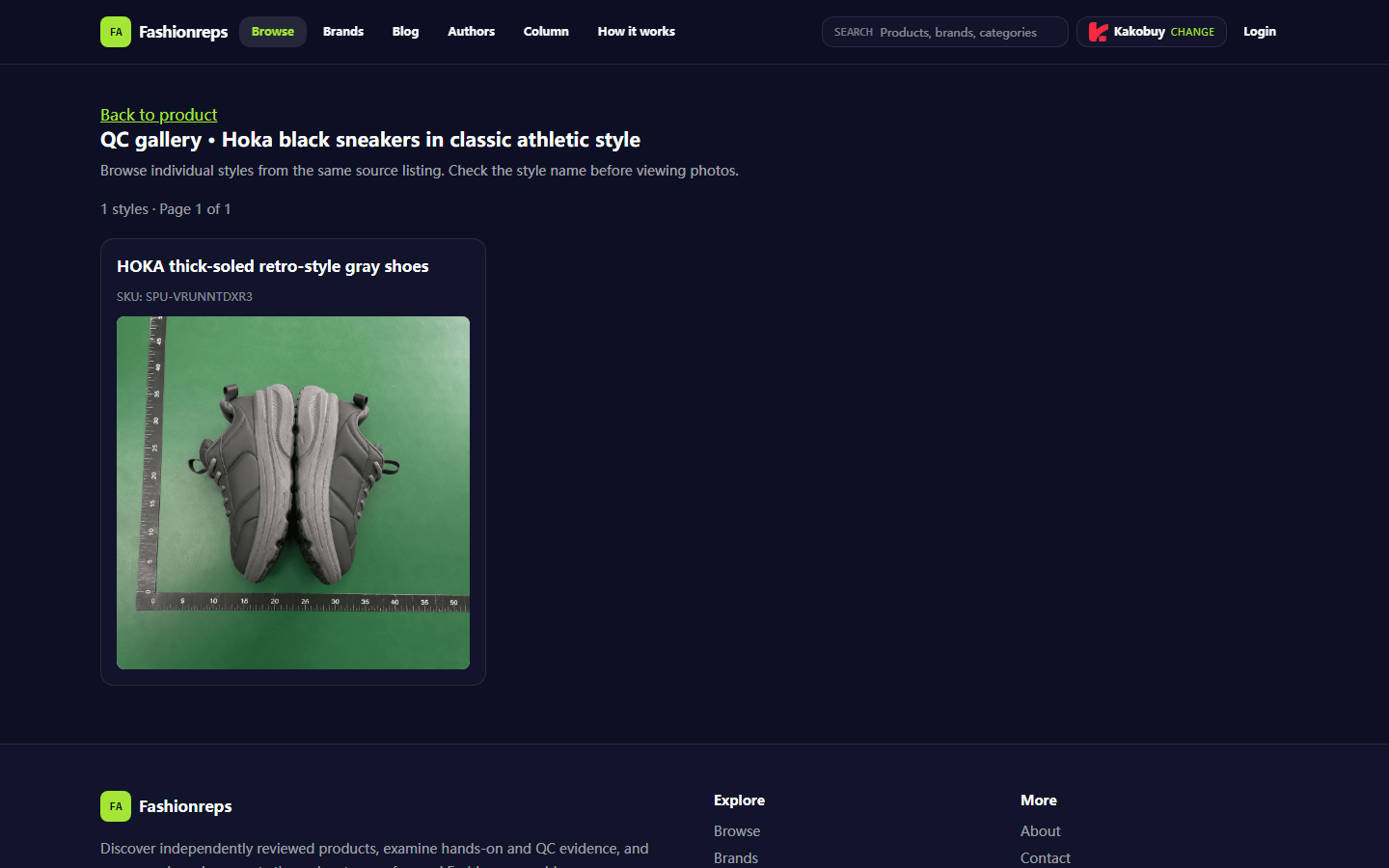
The subject of verification below is the QC page for a black hoka shoe style displayed on fashion-reps. The visible product information on the page includes the Hoka brand, a black shoe description, and QC images; as of October 13, 2026, existing records do not show a directly confirmable item price, packaged weight, destination shipping fee, or taxes, so this article does not fill in unverified specific numbers. 🧾

Record the Style, Size, and Current Price from the fashionreps Product Page
First, make sure you are recording the right style, not an adjacent item from the same source. The QC page shows that the source has separate style information, so you should verify the product name, SKU, or other page identifier before going to the agent platform.
Create a product record that includes at least the following fields:
- Product name: hoka winter shoes, and keep the original page wording.
- Brand and color: record the brand and color clearly shown on the page; do not guess the material or series from images.
- Style identifier: record the SKU, product page title, or any unique identifier visible on the QC page.
- Size: record the size you plan to buy, and note if the page indicates the sizing system.
- Item price: copy the currency and amount actually displayed on the agent page; do not treat a search summary or old screenshot as current price.
- Page status: record the query date, whether the page is accessible, and whether the price requires logging in, selecting a size, or choosing an agent to display.
If the price changes after selecting a size, save both the before and after display states. Shoe box dimensions, freebies, replacement packaging, or different sizes can also affect the final package weight, so do not only record the basic product info below the shoe image. 👟
Check Where Item Price, Service Fee, and Payment Fee Are Displayed
Do not treat the cart total as the parcel cost. At minimum, break the amount you see before payment into layers, and record the display location and applicable conditions for each layer.
The item price is the base amount for the shoes; the service fee may be calculated per item, order, purchase operation, or warehousing service; the payment fee may arise from payment method, account region, or currency conversion. If the page shows only one total amount without explaining the components, mark it as "to be confirmed," and do not arbitrarily attribute the difference to shipping.
You can record in the following order:
- On the product page, record the item price, currency, size, and query time.
- In the cart or order confirmation page, note whether the service fee is listed separately.
- On the payment page, check for any payment surcharge, currency conversion fee, or other additional charges.
- Capture or save the fee details, but blur out account, order number, payment card, and personal address.
- Mark each amount as "displayed," "system calculated," or "not yet shown."
fashion-reps helps users discover products, view QC evidence, and compare shopping agents; the actual order, payment, and international shipping are handled by the chosen agent's website. Therefore, the fashion-reps page cannot replace the agent platform's payment page, warehouse page, or shipping calculator.
Record Packaging, Weight, and Billing Basis for a Consistent Destination
International shipping must be tied to destination, route, parcel status, and billing basis. Recording only "shipping to country X" is usually insufficient, because different regions, postal codes, shipping routes, and item restrictions can change available options.
Before ordering, fix these conditions:
- Destination country and city, noting the postal code area if necessary.
- Currency unit, and the currency in which the agent platform displays fees.
- Expected number of shoes and size of each pair.
- Whether to keep the shoe box, use reinforced packaging, or combine packages.
- Whether the package will contain other items.
- Query time and the rate page used by the agent platform.
Also distinguish actual weight from volumetric weight. Shoe boxes usually add volume, and winter shoe packaging can also affect the billing result. If the agent only provides an estimated weight, mark it as estimate; only after the warehouse reweighs should you use it for verification. 📏
Combining packages is not automatically cheaper. It may reduce repeated first weight or some handling costs, but it may also increase package volume, chargeable weight, risk of loss in a single shipment, or declared value at destination. Splitting packages may add fixed costs, but when route restrictions, value limits, or item category restrictions exist, it may be easier to execute.
Therefore, only compare combining vs. splitting under the same destination, same currency, similar packaging conditions, and same billing basis. Without actual weight or agent calculations, do not claim that one approach definitely saves money.
Distinguish Fees Displayed on Page from Those Still Awaiting Official Confirmation
Fee records are best layered by evidence strength, rather than lumping all numbers into one total.
| Fee item | What to record now | When it can be considered confirmed |
|---|---|---|
| Item price | Amount, currency, size, query time | Payment page still shows same item and size |
| Service fee | Fee name, calculation method, whether tax included | Agent order details clearly list it |
| Payment fee | Payment method, surcharge, conversion notice | Payment confirmation page clearly shows it |
| Packaging fee | Original packaging, reinforcement, box removal options | Warehouse service page or order details show it |
| International shipping | Destination, route, weight basis | Warehouse weighs and completes shipping calculation |
| Taxes and customs fees | Whether paid by recipient, applicable conditions | Both agent and destination country official info verified |
If a fee has no separate field, do not infer its name just because the order total increased. For unexplained differences, first keep the original page and query time, then ask agent customer service for clarification. 🔍
Recheck Exchange Rate, Currency, Query Time, and Calculation Conditions
When comparing across currencies, keep the original currency; do not save only the converted amount. Exchange rates change over time, and payment institutions, bank cards, and agent platforms may use different rates or add conversion fees.
In a spreadsheet or order note, write clearly:
- Original amount and original currency.
- Target currency for conversion.
- Exchange rate source or conversion method used by agent platform.
- Query date and time zone.
- Whether payment fees, service fees, taxes, or estimated shipping are included.
- Whether the result is just a budget, not the final charge.
If the page does not disclose the exchange rate source, use the agent's settlement page as the actual payment reference, and treat external conversions only as a budget. Do not use old orders, forum comments, or outdated screenshots in place of current amounts. Amounts, inventory, routes, and fees are highly volatile; they must be rechecked before publishing or ordering. 💱
Stop and Seek Clarification When Fee Fields Are Missing
Pause payment in any of these situations: item price has no currency, amount unclear after size selection, service fee unexplained, packaging status unconfirmed, chargeable weight missing, destination route unavailable, or tax responsibility not stated.
After stopping, process in order:
- Return to the product page, confirm no error in style, size, or page status.
- Reopen the agent cart, check that item price and service fee are still consistent.
- Go to warehouse or shipping calculator page, fill in consistent destination and package conditions.
- Ask agent customer service for the missing field's name, calculation time, and applicable conditions.
- Save the customer service response and new order details; do not share full order, passport, payment card, or shipping label.
- Only proceed to payment or shipping when the fee components and responsibility boundaries are clear enough.
If the agent can only provide a vague total, the most prudent record is "cost verification incomplete," not padding with averages. For destination import restrictions, taxes, declaration, and customs requirements, rely on official destination country information and the agent's latest guidance; do not use undervaluation, splitting to evade taxes, or evading inspection.
Pre-Order Fee Verification Checklist for hoka
After completing the record, confirm each item:
- [] Product name, style identifier, size, and color correspond to the same page.
- [] Item price, currency, and query time saved.
- [] Service fee listed separately, calculation conditions clear.
- [] Payment fee and conversion notice checked.
- [] Destination country, city, or postal code fixed.
- [] Packaging, shoe box, and reinforcement options recorded.
- [] Estimated, actual, and volumetric weights not mixed.
- [] International shipping from agent's current calculator, not old screenshot or someone else's order.
- [] Taxes, customs responsibility, and import restrictions separately marked.
- [] All unconfirmed items remain "to be confirmed."
- [] Screenshots have personal and payment info blurred.
This verification method suits buyers who need to explain every fee before paying and are willing to wait for warehouse weighing. The savings cannot be predetermined without current price and weight evidence; the main reduction is unexpected spending from missed fees, wrong exchange rates, or misreading chargeable weight. The added cost is time for recording, re-quoting, and waiting for confirmation.
Do not combine or pay when price, weight, route, or tax responsibility are still missing; do not generalize one agent order's result as fixed cost for all hoka winter shoe parcels.
Community feedback (5)
Reader score 3.6 / 5 (5 ratings)
- lily_hauls
Kind of wish this mentioned that shipping winter boots is way more expensive than regular sneakers because of the weight. My pair weighed like 1.4kg each with the box. Ended up paying more in shipping than the actual shoes cost. Not the article's fault but still frustrating.
2 / 5- j_kowalski
Good breakdown. One thing I'd add - always check if the agent charges a service fee per item or per order. Some do per item which changes the math on multi-pair hauls a lot. For a single pair of winter shoes it barely matters but if you're ordering 3 pairs it adds up fast.
4 / 5- TomasRep
This is actually really helpful. I never thought about the packaging fee separately from the shipping fee. On my Hoka order the agent used a bigger box than needed and I paid extra for the volumetric weight. Next time I'll ask them to remove the original box. Lesson learned lol.
5 / 5- sneakergal_22
Honestly the exchange rate is what always gets me. You budget $60 for shipping then the rate shifts and suddenly it's $70. I started adding a 15% buffer on top of whatever the agent's calculator says. Saved me from a surprise charge last month.
3 / 5- mike_t_88
Been burned before by only looking at the product price. The agent fees and packaging on a bulky winter boot can sneak up on you big time. My last haul had a pair of boots that cost almost 40% of the item price just in shipping because the box was huge. Definitely ask for a quote before committing.
4 / 5
Keep reading on this site
Patagonia Jacket: Split Costs & Verify Savings Before Order
## Defining Cost Decisions and Savings Boundaries for Patagonia Fall/Winter Jackets If you're planning to find a [Patagonia](https://fashion-reps.net/brand/patagonia) fall/winter jacket through a fashion-reps page, the first issue you need to solve isn't "which ordering method is cheapest," but whether you can compare the product price, agent service fee, payment fee, packaging fee, international shipping, exchange rate, and possible taxes under the same calculation framework. 🧾 This article ha
Fear of God Essentials Hoodie Review: Fit, Sizing & Checks
Introduction If you're judging whether a [Fear of God Essentials](https://fashion-reps.net/brand/fear-of-god-essentials) fall/winter hoodie is worth ordering on fashion-reps, the first thing to solve isn't "does it look similar," but whether the page evidence truly corresponds to this hoodie. The actionable goal of this article is: complete product page checks, organize fit and sizing evidence, distinguish the proof scope of page specs and QC photos, and stop ordering in time when information is
Verify Gucci Sunglasses Coupon on fashionreps
## Clarifying the Checkout Problem That Verifying a gucci Sunglasses Coupon Solves When buying [gucci sunglasses](https://fashion-reps.net/accessories/sunglasses/gucci), whether a coupon can be used cannot be determined solely by the discount percentage shown on the promotional page. What truly needs to be confirmed is: whether this coupon applies to the current item, current variant, current purchasing platform, and current order amount, and whether the discount will be correctly reflected befo