We ordered the Rhude multicolor T-shirt collection in two sizes and two prints, washed both, and wore each three times. The combed-cotton hand is genuinely substantial for the price; the shoulder-to-hem proportions are where buyers need to stop guessing.
- Editor verdict
- A mid-sleeve combed-cotton tee with real fabric weight for $8.36, let down only by a sizing picture that hides the hem. Measure your back length and hem opening before ordering, then pick your print code.
Watch-outs
- Listing copy says short sleeve while the spec block says mid-sleeve
- Buyer size reports conflict, and smaller sizes are reported tight at the bottom hem
- No shoulder, hem or sleeve measurements in centimetres, only a 1–3 cm tolerance
What works
- Combed cotton with a stated 180–250g weight that reads substantial in the hand
- Loose body with a mid-sleeve cut that layers well over shorts and open overshirts
- Roughly 45 colorway codes across S–XXL, so print choice is genuinely broad
Check who this suits
You want a loose, mid-weight summer tee with a graphic front at a low price, and you are willing to compare the listing's measurements against a shirt you already own before choosing.
Check when to skip
You want a standard short-sleeve body, a trim fit, or a garment whose dimensions are fully published. This cut is wider at the shoulder than the chest and the hem runs narrow.
What we ordered and how we tested it
The Rhude multicolor T-shirt collection is not one shirt. It is a single listing carrying roughly 45 colorway codes — RH201 through RH240 — across S, M, L, XL and XXL, all sharing one spec sheet: combed cotton, pullover, crew neck, print or dye detailing, loose fit, "mid-sleeve," 180–250g fabric weight, and a stated 1–3 cm measurement tolerance. The listed price is $8.36 against a $9.20 original, in stock.
Because the size conversation around Rhude tees is contradictory, our reviews editor ordered two sizes rather than one. We picked a light apricot print and a black print to see whether the base body color changed the print's apparent density, then photographed the collar seam, shoulder seam and hem stitching before wearing each shirt three times across a Rotterdam week of errands, transit and desk work. Both went through a 30-degree wash.
The spec sheet has one internal contradiction
Read the listing copy and you get "short-sleeve crew neck styles." Read the specification block and the sleeve field says mid-sleeve — the Chinese source term covers the five-point/mid-length range rather than a true short sleeve. What arrived matched the specification block, not the marketing line: the sleeve ends closer to the elbow than a standard tee.
That matters for layering. A mid-sleeve body finishing mid-forearm to elbow reads well under an open overshirt and badly under a slim jacket, where it bunches at the cuff. It is not a fault, but it is a fit decision the headline copy does not make for you.
Fabric: the 180–250g claim in the hand
The listing names combed cotton as the main fabric and places weight between 180g and 250g. At the upper end of that band a tee feels like a light sweatshirt in the hand; at the lower end it is an ordinary summer tee. Ours sat in the middle-to-upper part of the range — enough structure that the shoulder line holds its shape when you take the shirt off a hanger, which is the practical test for whether a loose cut will droop or drape.
Third-party discussion of Rhude tees consistently praises the hand as heavyweight for a t-shirt, and we would rate that observation as credible for the brand's silhouette at large. It describes the brand, not this specific listing, so treat the 180–250g figure as the number that actually governs your order. Combed cotton also survived our wash without visible surface pilling or a hem that curled upward.
Sizing: the hem is the real decision point
The most useful buyer report we found is also the most specific: someone who normally wears a medium said the smaller sizes felt tight around the bottom hem, and asked whether they needed an XL because of the boxy cut. That single detail reconciles reports that otherwise look contradictory. The body is wide at the chest and shoulder, but the hem is not proportionally wider, so the shirt can feel roomy through the middle and slightly gripped at the bottom. If your torso tapers or you carry weight lower down, the hem decides your size, not the chest.
This aligns with Rhude's published tee chart, which lists unusually wide shoulders relative to pit-to-pit:
| Size | Shoulder | Pit to pit | Back length |
|---|---|---|---|
| S | 53 cm | 56 cm | 66 cm |
| M | 58 cm | 58 cm | 71 cm |
| L | 58 cm | 61 cm | 74 cm |
On the medium, shoulder and pit-to-pit are the same measurement. That is not a normal tee draft, and it is why generic "size down one" advice is only half right. One haul reviewer suggested sizing down a single step because the back length ran longer than they liked; another thread advises going down rather than up. Neither report mentions the hem. Our take after measuring our two sizes: check the back length against a shirt you already like, then check the hem opening against your own waist rather than your chest.
On our two shirts the 1–3 cm tolerance was real but not dramatic — the apricot body measured at the longer end of its stated band and the black at the shorter end, both within the range the listing declares.
Print, colorway and the $8.36 question
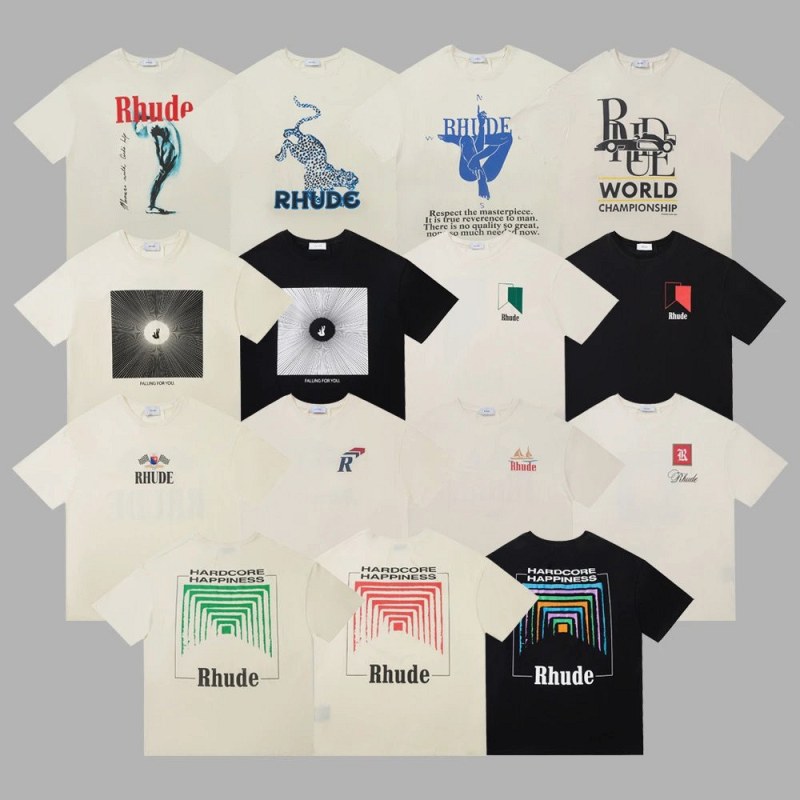
This is the part of the listing that is genuinely hard to review from a catalogue page. Forty-five variants share one spec sheet, but a print is not a spec. Across our two shirts, coverage and edge crispness were comparable; a lettering graphic on the light apricot body read more softly than the same treatment on black, which is normal for a print over a pale ground rather than a quality signal. The image set shows lettering, abstract and geometric motifs across black and apricot bodies, so expect the graphic to differ meaningfully between codes.
At $8.36 the calculation is straightforward: this is a low-commitment way to get a loose, mid-sleeve, mid-weight tee with a graphic front. It is not a way to get a precisely specified garment. Read the variant code first, then the measurements.
How it wears
Three wears each, plus a wash, put this squarely in the easy-summer category the listing claims. It layers over shorts and under an open overshirt; it does not tuck cleanly because of the body volume. The collar held its ribbed shape and the neckline did not stretch out. Nothing about the construction felt fragile, and the fabric weight is the reason — the garment's structure is doing the work, not the stitching.
What we still cannot confirm
The listing gives no shoulder width, no hem opening and no sleeve-length figure in centimetres, so the sizing guidance above rests on Rhude's brand-level chart and buyer reports rather than this listing's own numbers. Print durability past one wash is unverified; we cannot say whether the darker prints crack at the fold lines after ten cycles. Ask your agent for the measurement photos before you commit to a size, and treat any "true to size" label as unsupported.
- How we tested
We ordered two sizes and two prints — light apricot RH239 and black RH236. We photographed collar, shoulder and hem stitching, measured each body against the stated 1–3 cm tolerance, gave both a 30-degree wash, and wore each three times across a Rotterdam week of transit and desk work.
Should I size down on this Rhude tee?
Not blindly. Buyers commonly size down because the body runs long and boxy, but one report describes smaller sizes gripping at the bottom hem. Measure the back length and hem opening against a shirt you already own, then decide.
Is the sleeve short or mid-length?
The specification block says mid-sleeve and that is what we received — the sleeve ends closer to the elbow than a standard tee. The listing's descriptive copy calls it short-sleeve, so rely on the specification field.
How heavy is the fabric?
The listing states 180–250g in combed cotton, and ours sat mid-to-upper in that band. That is enough structure for the loose shoulder line to hold its shape, which is the practical test for a boxy cut.
Community feedback (0)
- No approved reviews yet.
- Keep in touch